
Putting democracy to the test
Adjudicating for Democracy? How Backsliding Theories Shape Legal Interpretation
Henrique Almeida de Castro usually studies state-society relations and participatory democracy, rather than judicial behaviour. Therefore, his current project “has been an intriguing challenge,” he says. He takes a historical perspective on the challenging relation of politics and law in state power: “My research examines how theories of democratic backsliding influence judicial interpretation and decision-making,” explains Henrique. “As concerns over de-democratization grow, constitutional courts are increasingly urged to strike down potentially harmful reforms – even when they appear permissible under traditional standards. However, even when courts acknowledge backsliding, it remains unclear whether this awareness genuinely alters legal interpretation or merely serves as a rhetorical justification for self-serving rulings. This is because most cases to which these ideas may apply directly or indirectly affect judges.”
To address this issue, the historian from Brazil analyses judicial decisions on administrative reforms by Brazil’s far-right president, Jair Bolsonaro. These reforms targeted participatory institutions with no conceivable impact on the judiciary – yet were still blocked despite similar reforms having been allowed in the past. “I argue that judges, having embraced the idea that courts have a responsibility to combat democratic backsliding, found legal arguments framing such reforms as threats to democracy more persuasive than before, ultimately shaping their decisions.”

Henrique Almeida de Castro
What is democratic backsliding?
Democratic backsliding is one pathway to de-democratization, meaning that democratic politics become undemocratic. It is an alternative to the more classic pathway of coups. Backsliding occurs not through a single radical break but through the gradual accumulation of changes that make contestation more difficult, thereby enabling an initially democratically elected leader and their allies to remain in power. In a sense, this is not unlike the Nazi rise to power in Germany. However, backsliding does not necessarily lead to full dictatorships where elections become meaningless. Instead, competition may remain real but become unfair because elected leaders use the state’s capacities to attack and co-opt opponents.
What is autocratic legalism?
Many changes that aspiring autocrats promote have a legal form: strategies such as serial extensions of presidential term limits or the replacement of critical judges occur through constitutional amendments, laws and other legal instruments. Autocratic legalism refers to how aspiring autocrats utilize legal form and the language of legality to make a grand display of governing through legally permissible means. This does not necessarily mean that all their reforms are, in fact, permissible (this is a matter of local legal interpretation) but that they perform a convincing appearance of legality. This performance helps them deflect criticism and deny charges of promoting backsliding.
When did the phenomenon of democratic backsliding first emerge?
According to Henrique, it is difficult to determine the first instance of democratic backsliding. The best-known cases of countries that have experienced it are Poland under Andrzej Duda, Venezuela under Nicolas Maduro and Hugo Chávez, and Hungary under Viktor Orbán.
“Rather than backsliding itself, what is more important to my research is the growing popularity of the idea of democratic backsliding. Since the late 2010s, this concept has broken through the walls of academia and shaped public debate; the most significant moment in this movement was probably the publication of Steven Levitsky and Daniel Ziblatt’s book, “How Democracies Die”, in 2018. A Brazilian version of this book was published during the 2018 elections, which Bolsonaro won, and became an instant bestseller. It shaped the public debate and perception of what kind of danger Bolsonaro posed. I find it remarkable how, despite Bolsonaro being an ex-military man in a country that spent much of the 20th century under a military dictatorship, people were more concerned with backsliding than a coup. I do not think this would have happened if this concept had not been developed.”
As backsliding happens gradually, it can be hard to notice until it is too late – that is, in Henrique’s opinion, the danger of this phenomenon. “I believe another type of danger is more relevant to my project, namely the danger of a “juristocracy”. The problem with relying on courts to fight backsliding is that they do so by striking down reforms promoted by an elected leader while judges themselves are not elected. This might be fine when you have recognizably illegal reforms.”
Still, academic discussions on backsliding and autocratic legalism often point out that reforms may appear innocuous before it is too late and may appear permissible by traditional standards. This means that courts must identify threatening reforms without much clarity on how to do so. This might lead even judges acting in good faith to extend to block democratically legitimate reforms. “Some reforms, such as the serial term limit extensions of presidents, have already been demonstrated to be detrimental in many countries. That means there are some easy cases. However, we lack clarity on many other potentially threatening reforms, including the administrative ones that I am examining in this project,” says Henrique.
Except for his analysis of Brazil under Jair Bolsonaro, Henrique is also examining other countries that have experienced democratic backsliding – such as Poland under Andrzej Duda, Venezuela under Nicolas Maduro and Hugo Chavez, and Hungary under Viktor Orban. “There are others, such as Russia, the Philippines and Turkey, but these are more contentious examples that often spark disagreement among academics.”
The solutions the Postdoctoral Fellow proposes focus on the challenges of judicial decision-making. He argues that academics could help more by spending more energy on studying less understood reforms that might conceivably contribute to backsliding. “Most of the current work is dedicated to refining our understanding of reforms that many academics have already agreed to be constitute threats. But there is little clarity over many others. For example, consider the participatory institutions that Bolsonaro wanted to reform. If he had succeeded, would Brazil have come any closer to becoming non-democratic? It is equally easy to think of arguments supporting or opposing this notion, and academics would likely disagree on the answer. Yet, academics are saying this should be a relevant question for decision-making.”
Henrique reports that academics like him are advising judges to be cautious about backsliding (and they are listening!) without equipping them to identify threatening reforms beyond a few well-known examples. “In court, litigants fill this gap by using backsliding theories to frame judicialized cases as threatening, but litigants are rightly strategic and selective in their arguments. This raises the danger of judges striking down legitimate reforms or failing to identify those that pose a threat.”
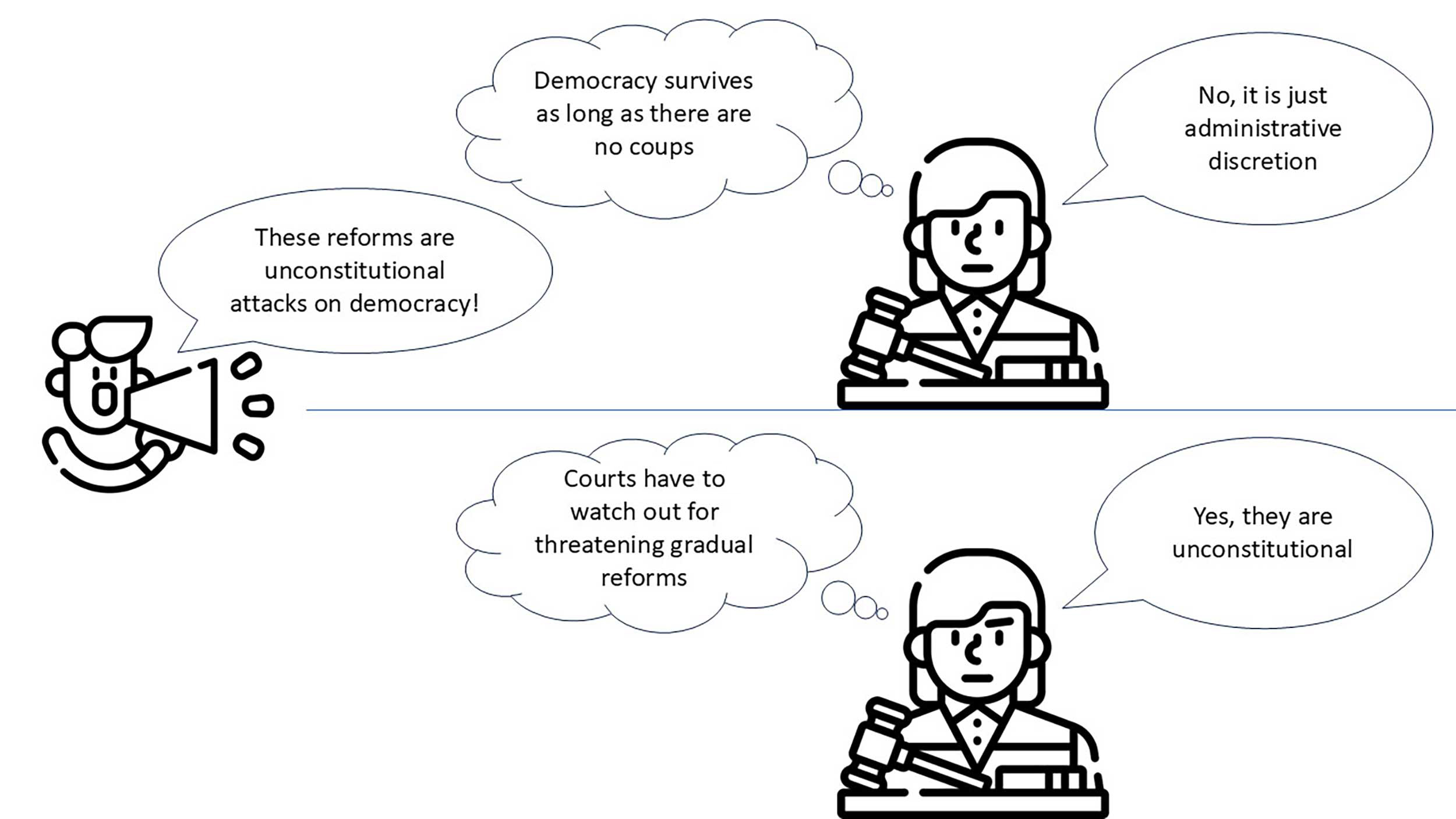
“The same judges can respond differently to the same legal arguments depending on whether they think gradual reforms can threaten democracy.”