Making the invisible visible
In 2025, the Zukunftskolleg started a collaboration with the Merz Akademie - University of Applied Arts, Design and Media in Stuttgart – with the aim of translating scientific outcomes into artistic work.
How can we combine different types of media, using photos, illustrations, videos and scientific data for interactive storytelling? – This was the main question of the “Making the invisible visible” project, in which students of the Merz Akademie worked together with researchers from the Zukunftskolleg on the use of virtual reality (VR) and augmented reality (AR) technology for interactive narratives and multimedia experiences.
Use case was the research on soil pollution and its environmental impact conducted by Postdoctoral Fellow Angelo Neira. The aim was to provide visualizations that show the pollution in soil and the complex task of applying sustainable solutions to the associated problems.
Project start
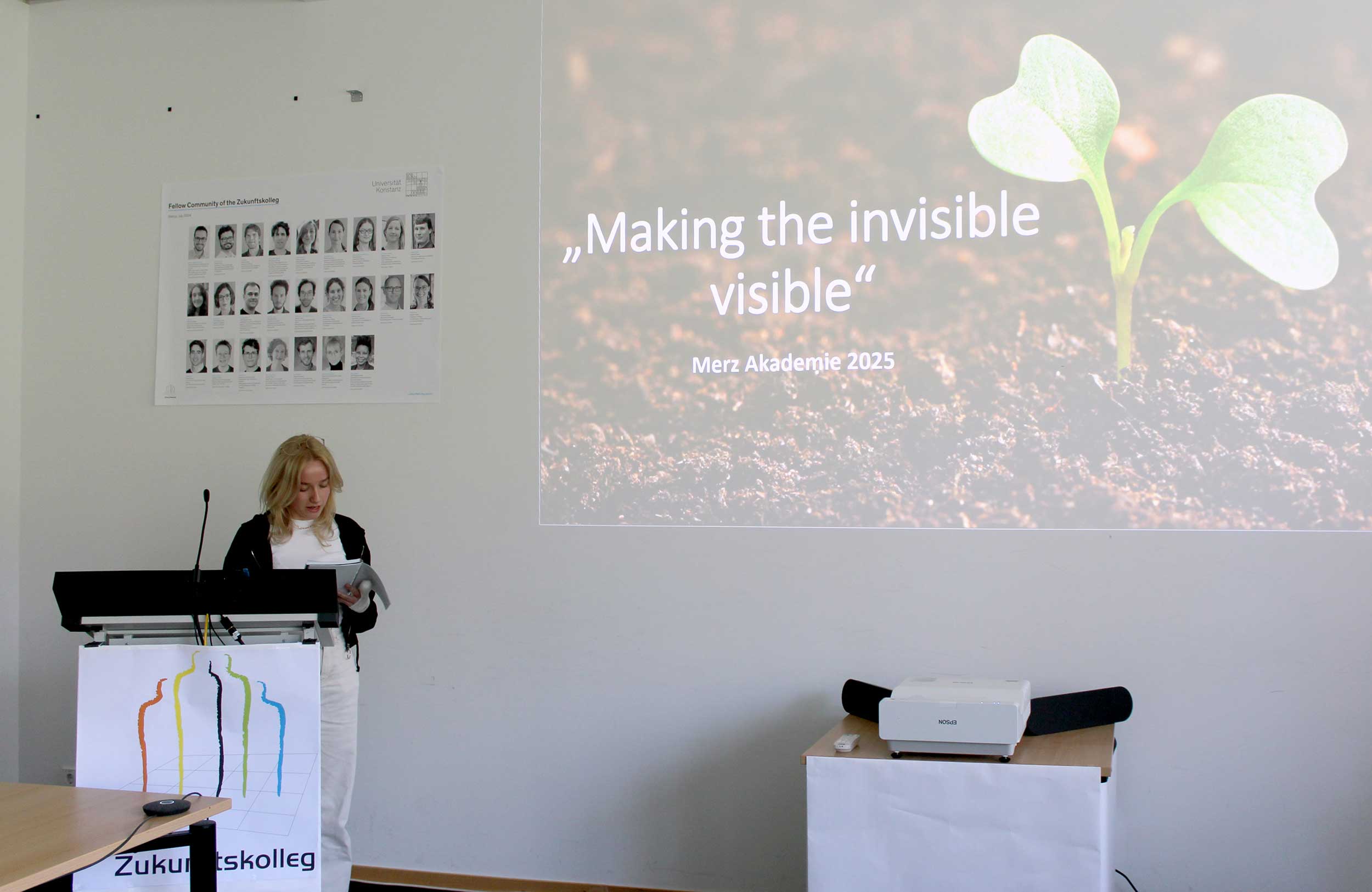
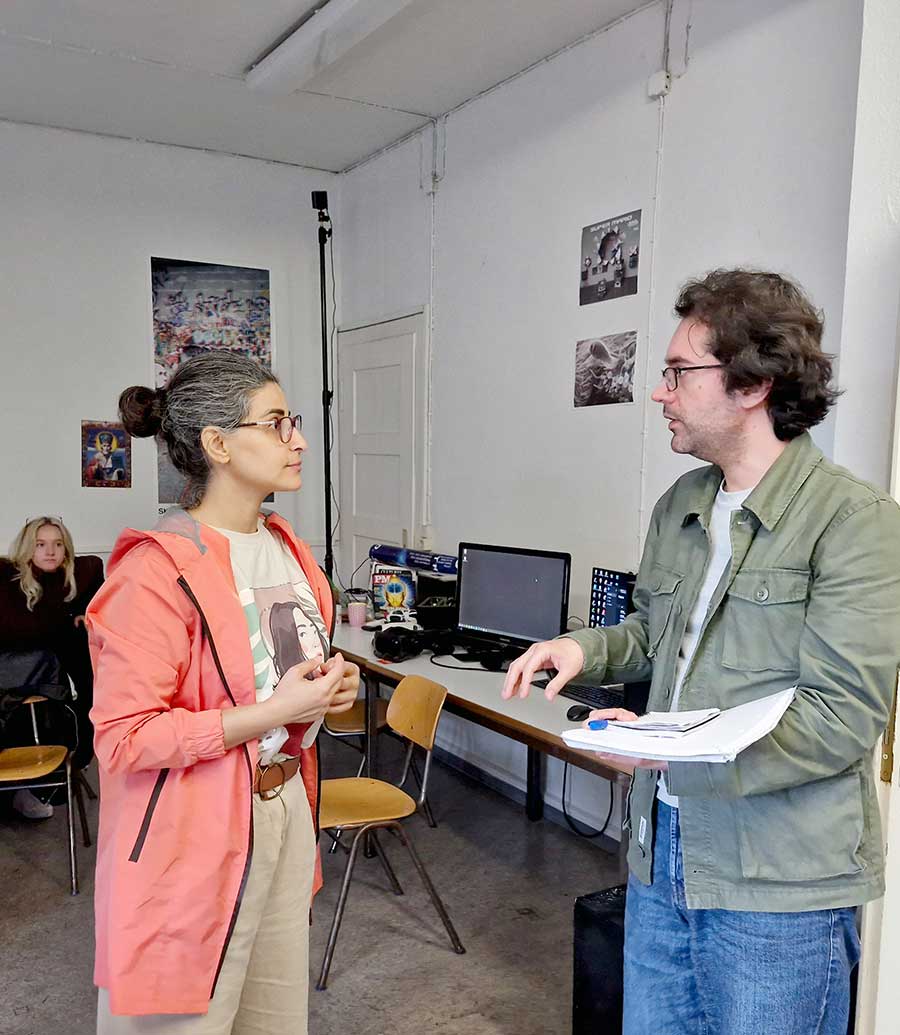
On 26 March, Angelo Neira visited the Merz Akademie for the start of the cooperation project. Mario Doulis, Professor of New Media at the Merz Akademie, introduced the main goals of the project. Having given an overview of his research on soil pollution and its environmental impact, but also the different meanings of the term “soil”, Angelo Neira developed, together with the students, a first understanding of the complexity of the term “soil” and the measurement of soil pollution, its interpretation and its impact on decision-making processes on different levels. On the same day, Eduardo Luersen gave an online presentation of his project “Humming: Data/Transfer/Heat”, which discusses environmental implications of data centres and fictional possibilities for the use of sound in environmental storytelling related to the project (“Making the invisible audible”).
Excursion 1
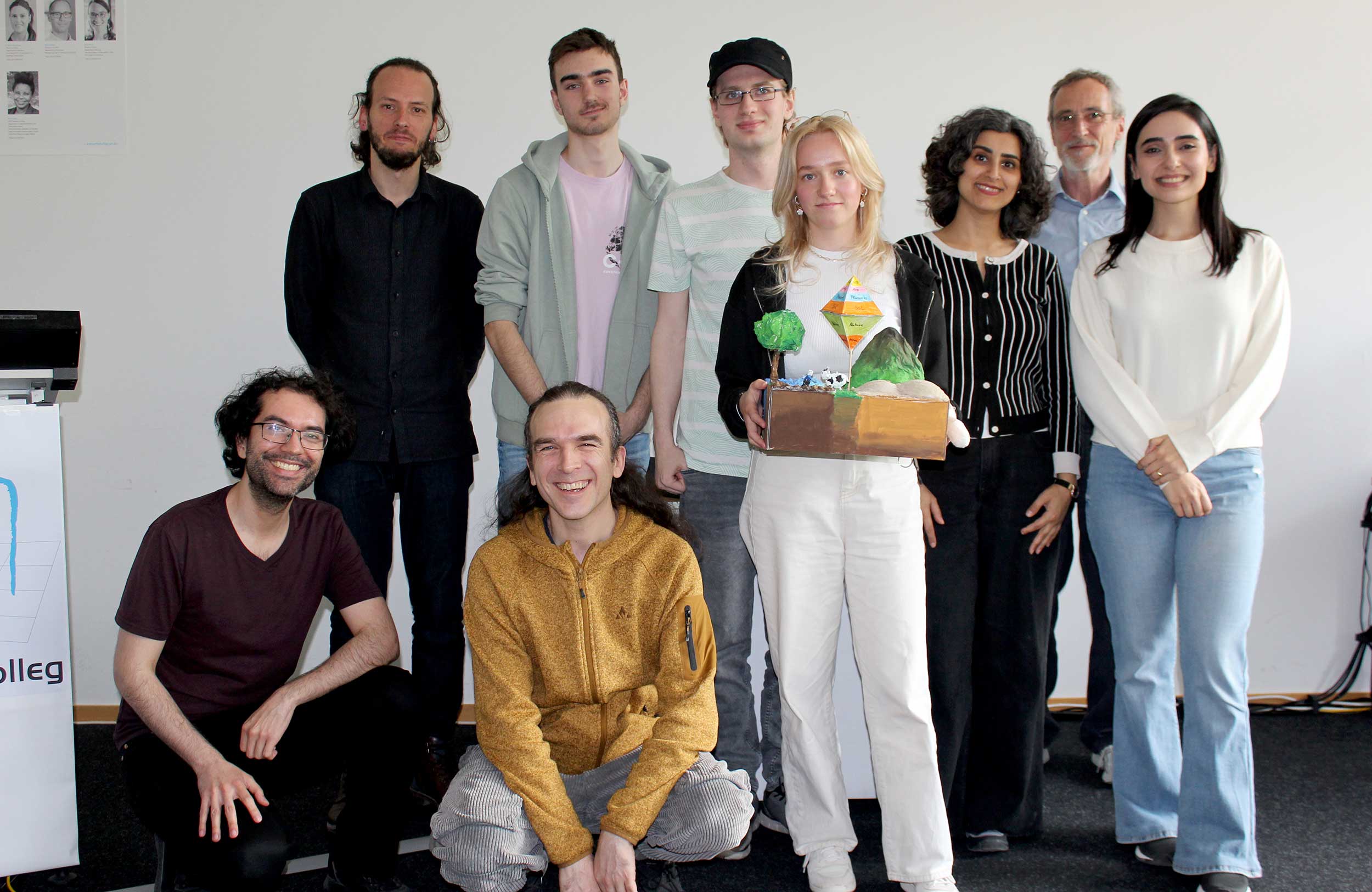
On 15 and 16 April, students from the Merz Akademie visited the Zukunftskolleg. They were accompanied by Mario Doulis, the project supervisor, and his colleague Jörg Frohnmayer. After Giovanni Galizia had taken them on a tour of the university campus, where he explained the history of the buildings and the works of art that can be seen here, the students presented their first ideas and concepts as part of the weekly Jour fixe. Together with Postdoctoral Fellows Angelo Neira and Eduardo Luersen, they then discussed their work and the next steps in two brainstorming sessions.
Excursion 2
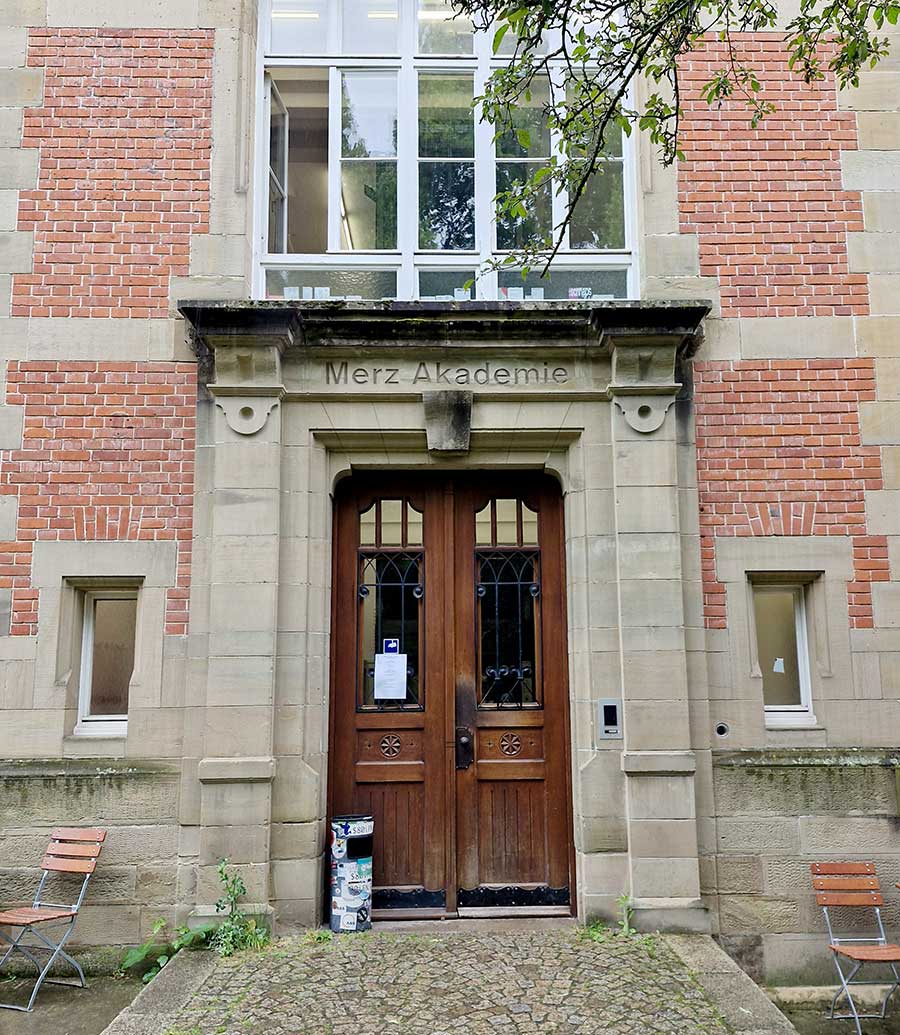
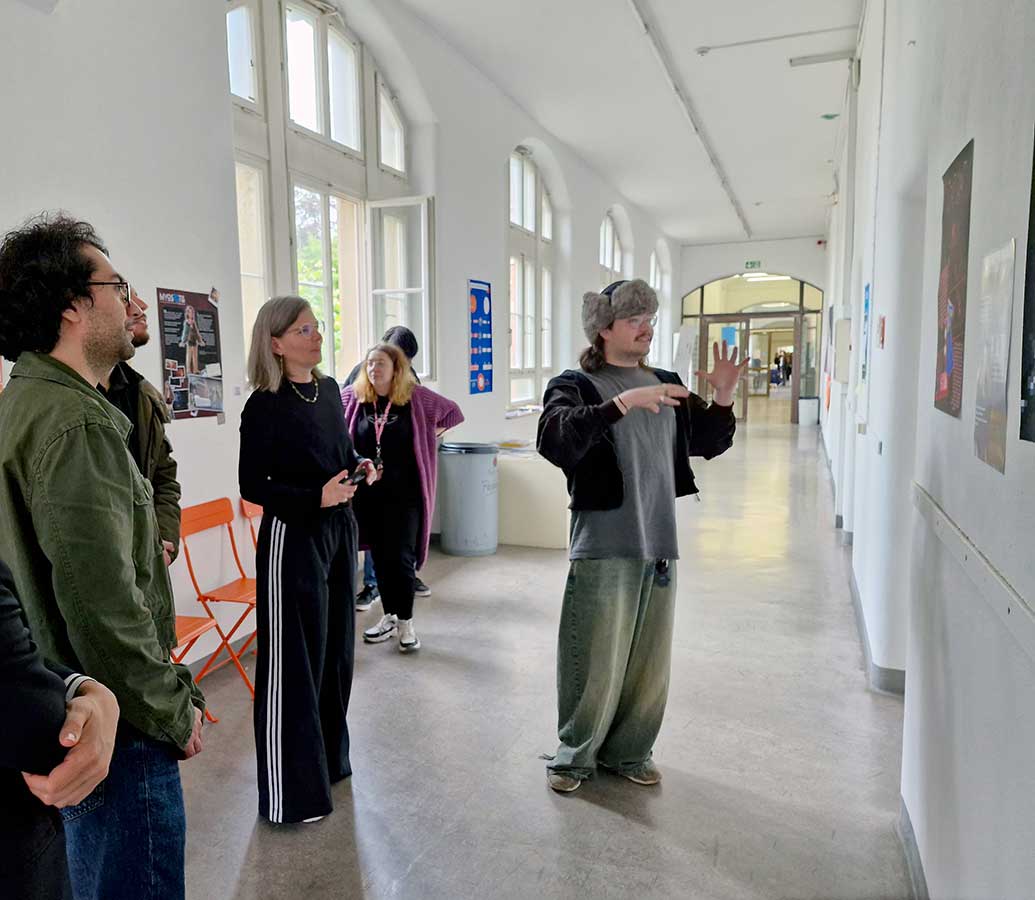
On 28 May, Angelo Neira, Eduardo Luersen, Philipp di Dio, Laura Dirmaite and Sigrid Elmer from the Zukunftkolleg visited the Merz Akademie in Stuttgart. After a tour of the Merz Akademie, the ZuKo members had the opportunity to see all current semester projects during an open day there.
In addition to the visits to Konstanz and Stuttgart, Angelo Neira and Eduardo Luersen supervised and assisted the students continuously via video calls and emails.
Final presentation
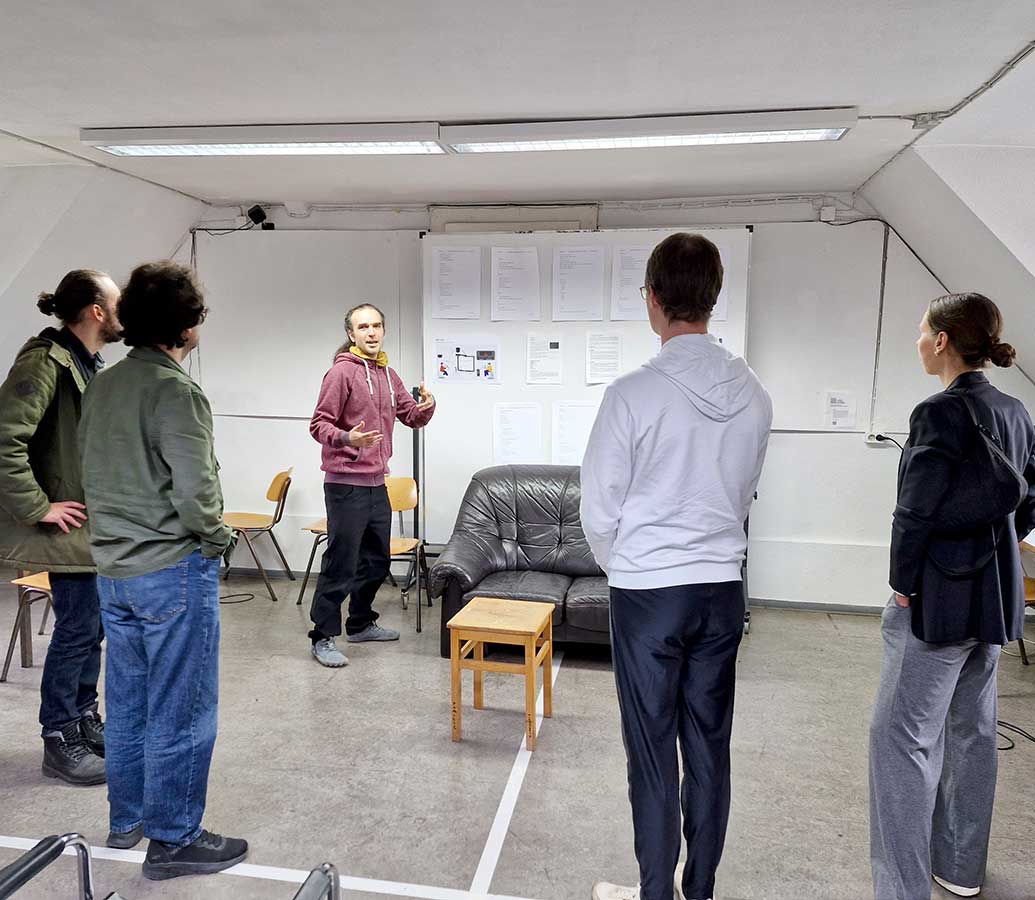
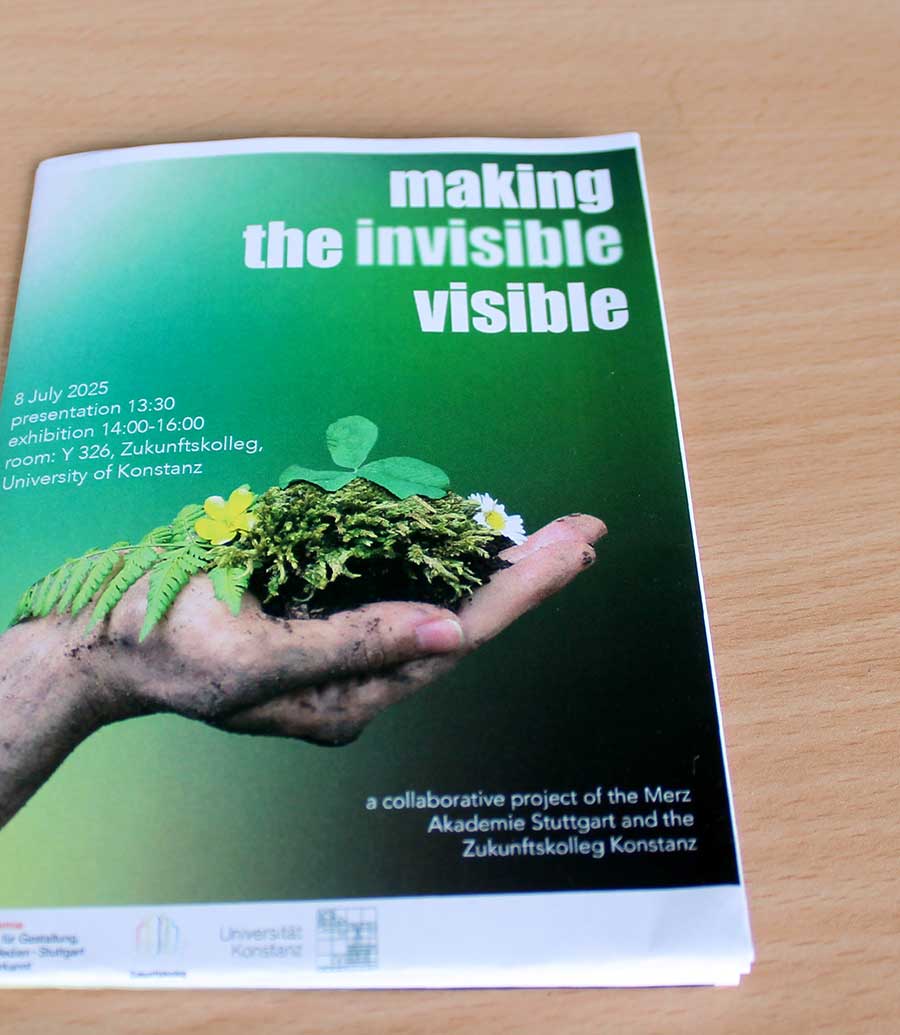
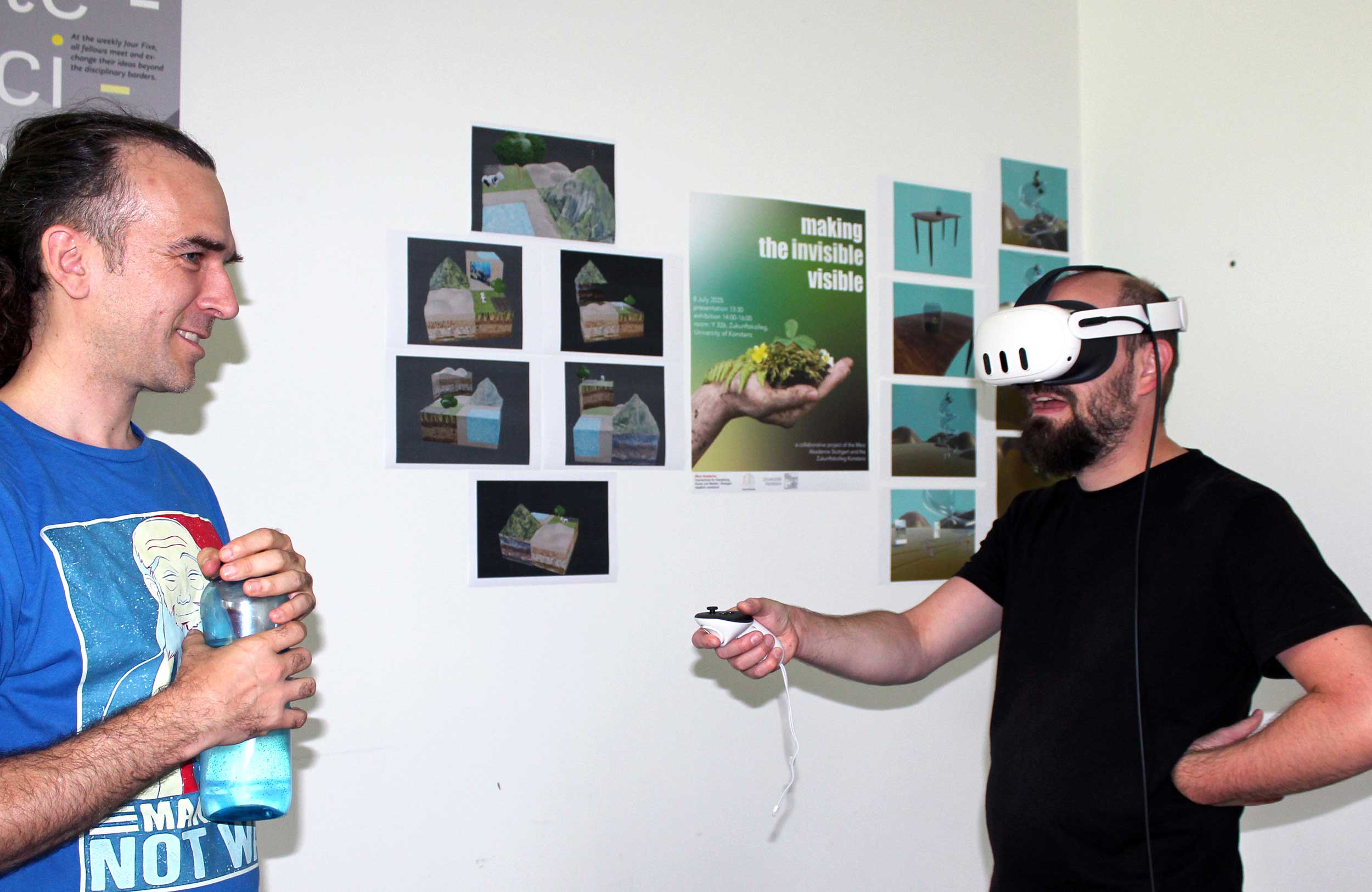
The final presentation of the science-art project “Making the invisible visible” took place as a public event on 8 July at the Zukunftskolleg.
The prototypes of the five interactive virtual worlds created by the students show artistic and design approaches for implementing and presenting complex (scientific) issues in a comprehensible way.
Project by Diana Hähnlein
Soil in many different ways
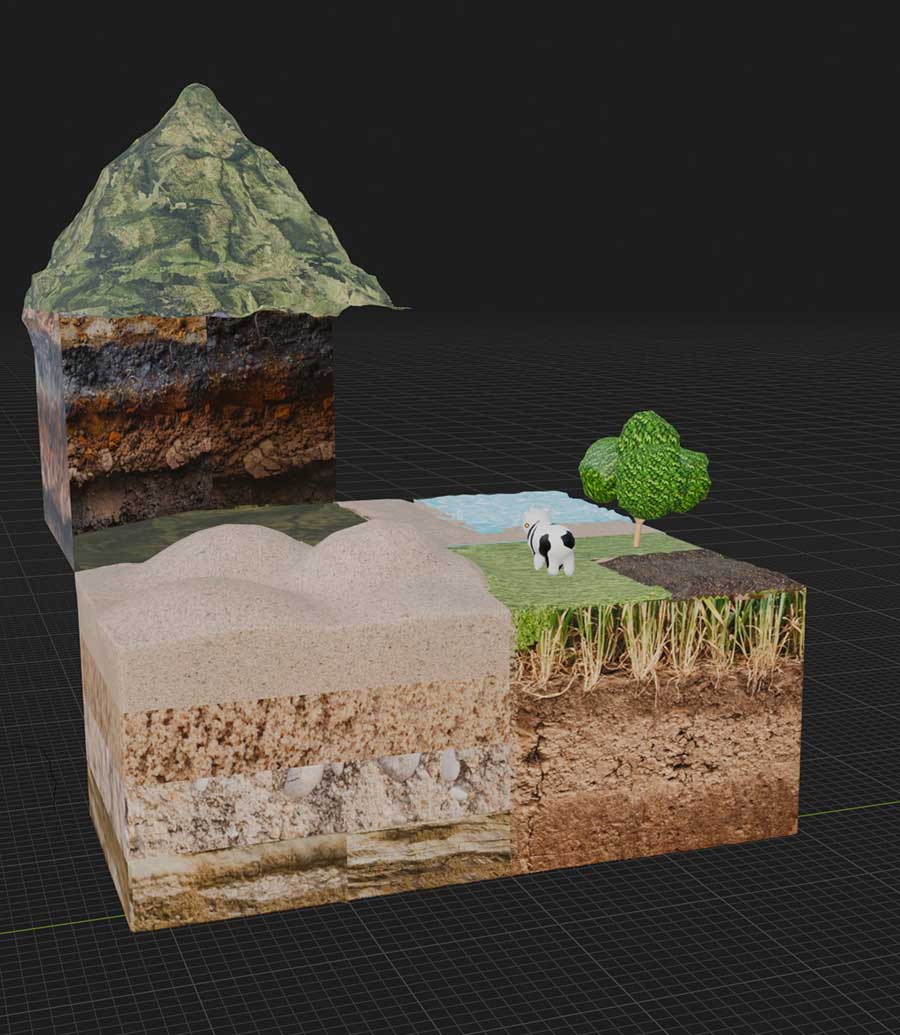
The project goal is to gain a deeper insight into the different structures of soil in different environments. Four different landscape types, each with its own unique biotopes, have been designed as interconnected worlds in virtual reality, showing a typical setting of each landscape. By moving the worlds, they become presentation spaces that allow users to discover “hidden layers” through audio-visual material and interactive objects that can be found there.
The design of the virtual world is based on the information visualization technique of “details on demand”, providing one coherent, interactive information space.
Project by Davide Ebner
Dig it up, label it, analyze it
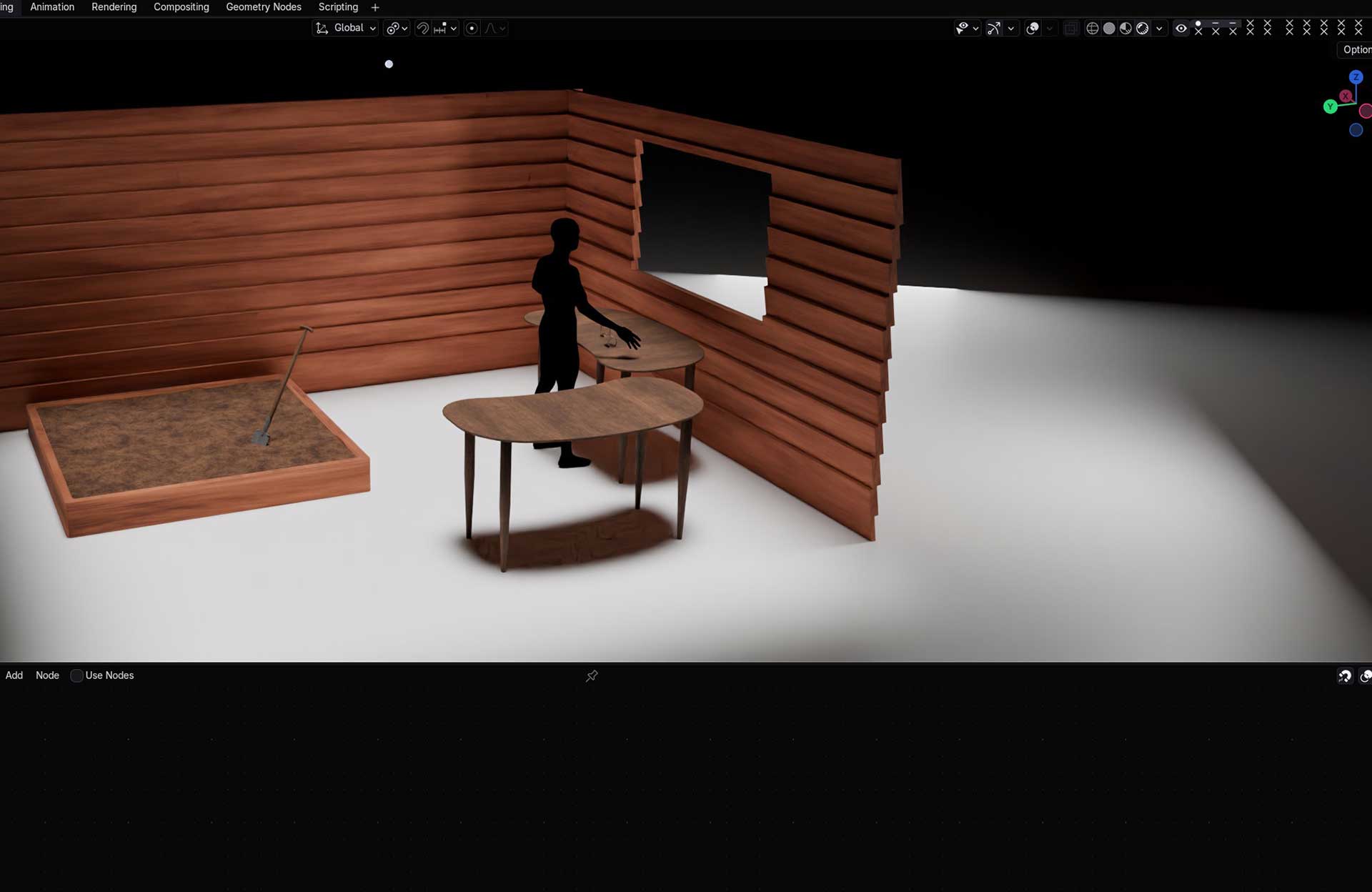
Soil serves many different purposes. And different soils have different compositions, causing different effects. For analyzing soil, the effect of adsorption plays an important role, describing how many pollution particles can connect to the soil particles. Comparing the original amount of particles on the soil with the one after washing it makes it possible to determine the adsorption strength of a specific soil and its pollution.
The aim of the project was to design a virtual world in which users can experience the process of taking soil samples, processing them, obtaining information about their pollution and an insight into the scientific background. The virtual world combines a natural environment-like area where soil samples can be taken with a lab-like area where the samples can be processed. This area also defines the place where the users gain more detailed scientific information in the form of audio-visual materials. The design of the virtual world allows a seamless consolidation of information about the broader context and specific scientific aspects of the concept of soil.
Project by Elias Schaich
Soilbound
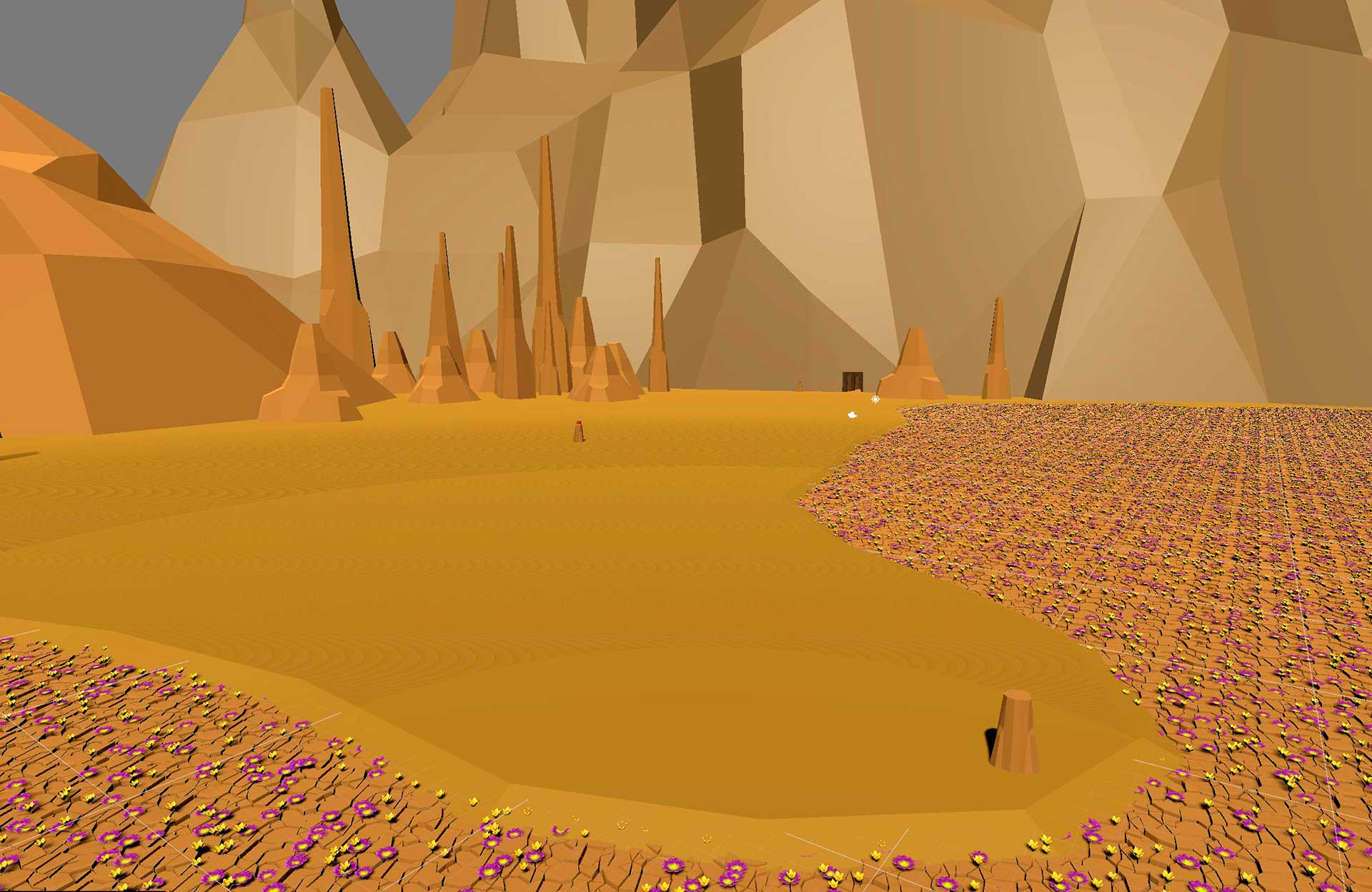
“Soilbound” is an immersive, interactive exhibition-like experience to engage users with a topic most people do not think about: soil.
The goal of “Soilbound” is to inform about the different meanings of the term “soil” in an interactive virtual world. Using a virtual jar filled with soil as an object to grab and put on different pedestals placed in the world, the user can unlock different animated and interactive exponents coming out of the ground. With each new exponent, the virtual world becomes more alive, showing all the diverse aspects of soil and starting to resemble a museum or theme park filled with information of all kinds. The storytelling concept of “Soilbound” combines conventional principles of information visualization with game-like elements in a very well-balanced way, providing a joyful experience without forcing users to engage in a complex game play with specific tasks or complicated interactions.
Project by Nina Jüttner
Invisible grounds
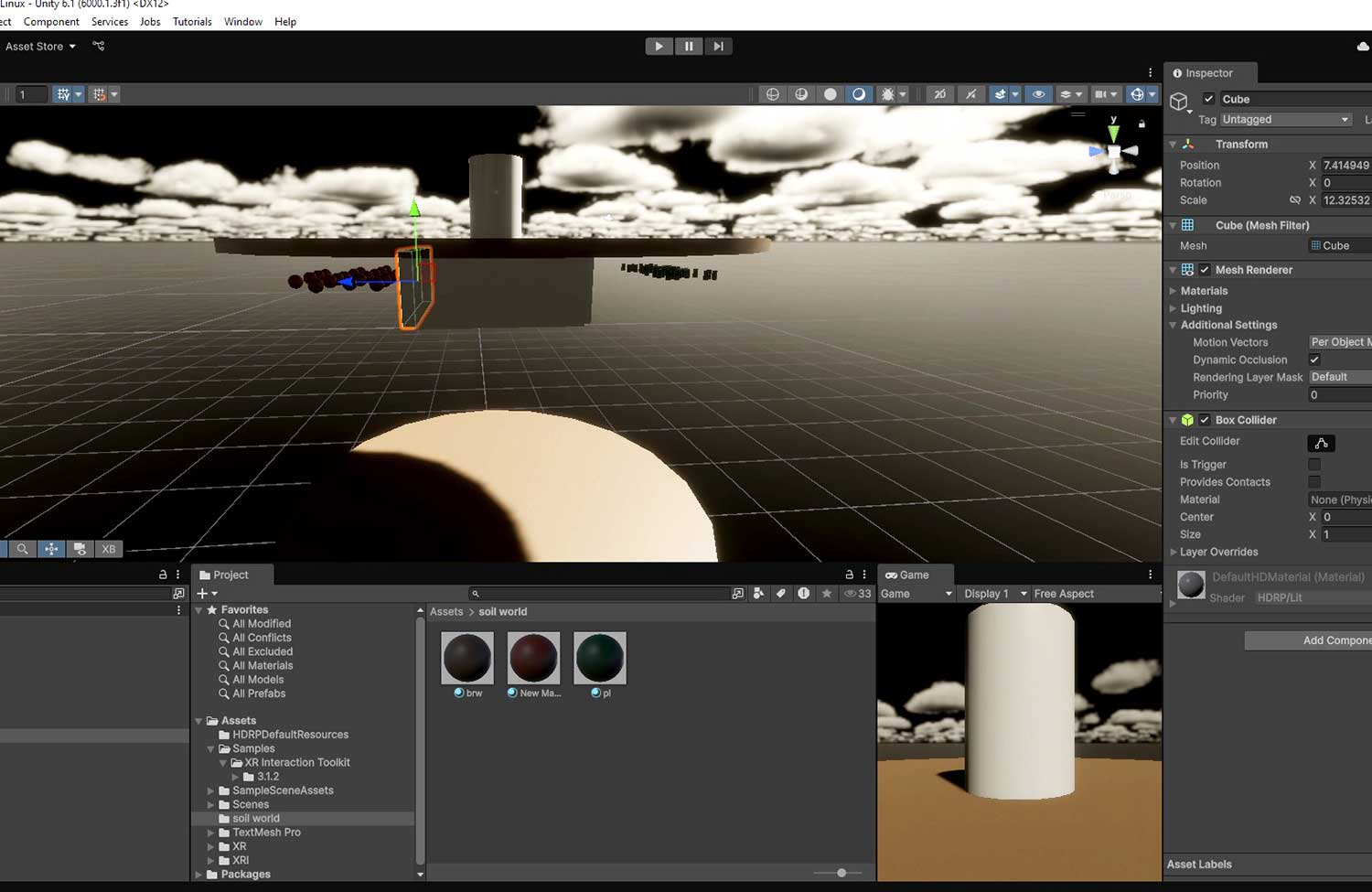
In “invisible grounds”, users find themselves in a virtual world on a dry plane of soil. A “virtual scanner” they find there lets them experience invisible things “hidden in the ground”. Things that appear only under specific circumstances (like seeds beginning to germinate in the rain), things that are always there, but not visible to the human eye (like some sorts of pollution), or any other kind of information and story about soil. It lets us see objects behind walls or underground, opening the door to another world.
Technically, one can describe “invisible grounds” as an augmented reality implemented within virtual reality. To achieve this, two (or more) worlds are implemented, with the “virtual scanner” offering an augmented view on both of them.
By switching the representation mode during runtime, it is also possible to see both worlds in their entirety at the same time, without needing the virtual scanner. To achieve this, the worlds have been adapted to each other in terms of content, 3D design and interactivity.
Project by Shadi Ahmadi
Semantic Soil – the Atacama Giant
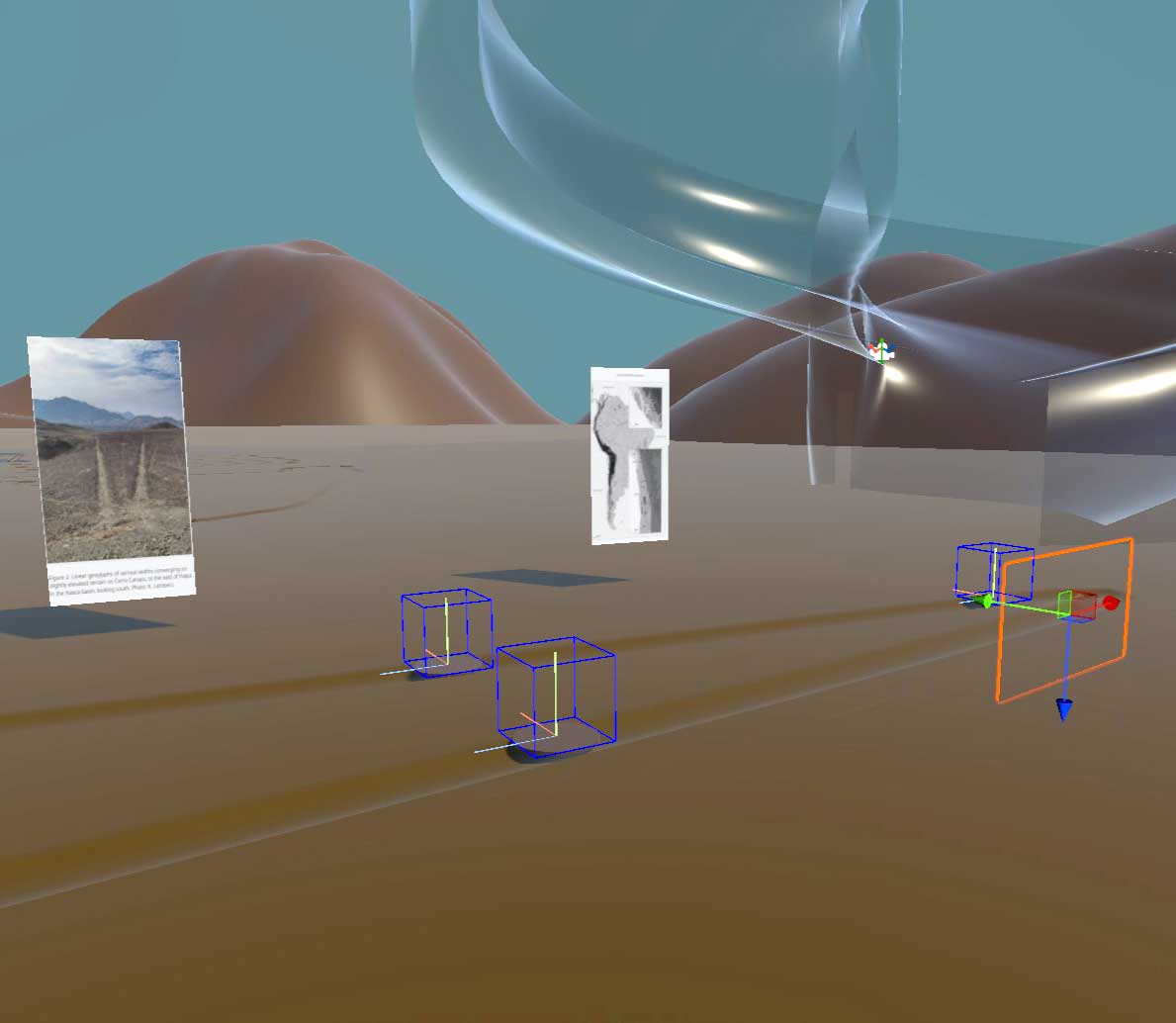
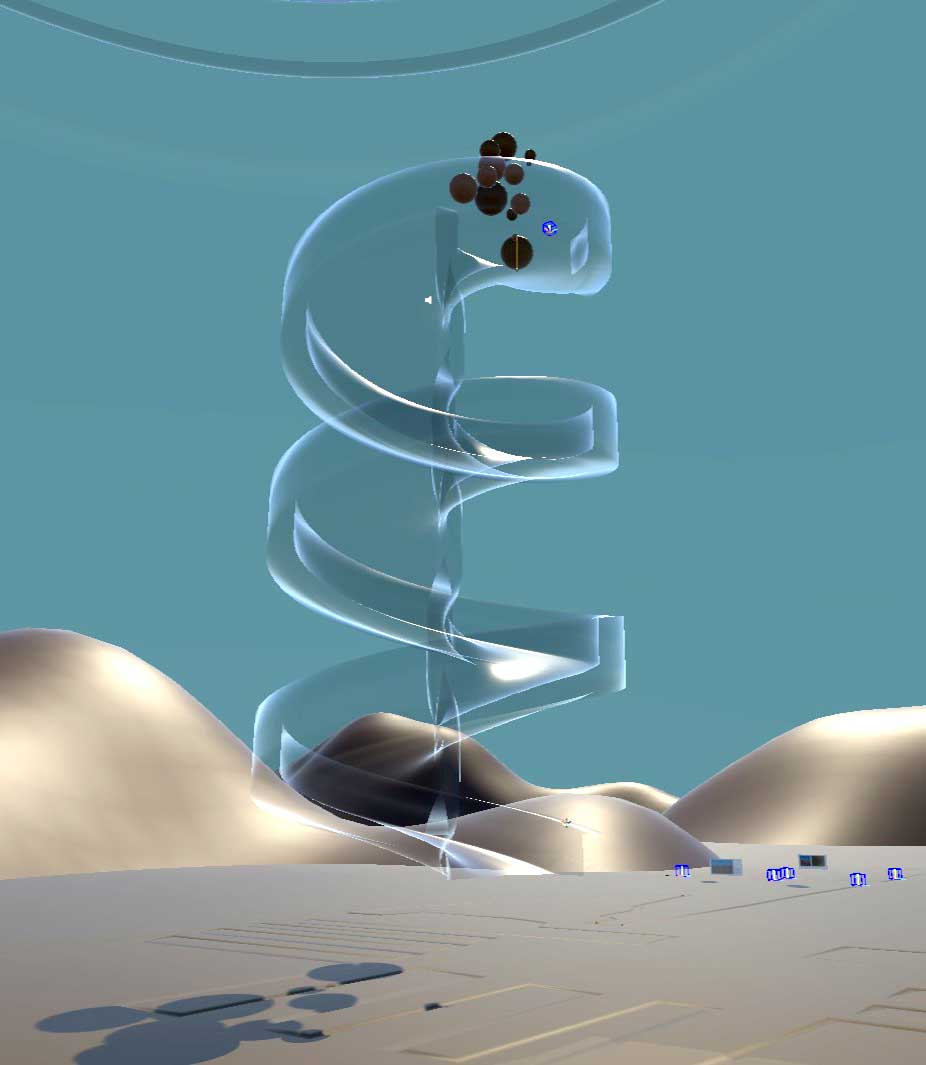
The aim of the project is to encourage viewers to see the Atacama Giant, a geoglyph in the Atacama Desert, as a meaningful part of the landscape and cultural heritage while emphasizing the importance of preserving historical artefacts in the soil and the impact of human-induced erosion.
Using VR, the user can experience the scale of this geoglyph (around 120 metres) from a top view, as well as from ground level, where it becomes a path, with the giant becoming “invisible”.
In “Semantic Soil”, the users are guided through a huge, transparent, walkable spiral from the top, offering a view on the Atacama Giant and the environment, to the ground, hearing an introduction into the topic. Once they reach the bottom, they can walk along the path (the outline of the giant figure), experiencing the huge dimension of the geoglyph like in the real world, finding more detailed information on their way.
The 3D design of “Semantic Soil” serves as both a virtual world to experience and an illustrative model to explain the storytelling concept. It follows the visualization principle of context and focus combined within a single (dynamic) display.
Outcome
From 8-12 September, Angelo Neira was presenting a poster entitled “Transdisciplinary soil literacy: Reimagining science communication through interactive storytelling” during the VIII EUROSOIL 2025 conference in Sevilla (Spain) which was based on the science-art project. “We are also exploring opportunities to continue developing these VR projects with external funds,” says Angelo Neira, looking to the future. “The collaboration has opened up new possibilities for exploring alternative modes of scientific communication and for enriching both the social and scientific dimensions of my subject of study.”
People involved
Zukunftskolleg Postdoctoral Fellows: Angelo Neira, Eduardo Luersen
Merz Akademie students: Diana Hähnlein, Shadi Ahmadi, Davide Ebner, Elias Schaich, Nina Jüttner
Merz Akademie course leaders: Mario Doulis, Jörg Frohnmayer
Organizers at the Zukunftskolleg: Sigrid Elmer, Laura Dirmaité