
Photographs of people with HIV
Andrei Zavadski and Katerina Suverina analyze photographs by Valery Khristoforov and Jürgen Baldiga

A nurse covers her face with a file folder.
Archive of Valeri Khristoforov, 1990

Three nurses at the station, two of whom are covering their faces. They are afraid that their friends and husbands will find out that they work with people who have HIV.
Photo of Valeri Khr
From 27 April to 26 May, the Zukunftskolleg welcomed Andrei Zavadski (TU Dortmund University) to Konstanz. He was invited by Postdoctoral Fellow Katerina Suverina (History and Sociology) to collaborate on a project entitled “People with HIV in Photographs by Valery Khristoforov and Jürgen Baldiga”.
The project analyzes photographic representations of people with HIV in works by Valery Khristoforov (b. 1948) and Jürgen Baldiga (1959-1993). Khristoforov and Baldiga lived and worked in the Soviet Union and (West) Germany respectively. “There is no record of them ever meeting or even being aware of each other’s work, and their photographic approaches differ significantly,” explains Katerina Suverina. Moreover, the two photographers represent separate lines of inquiry in Katerina Suverina and Andrei Zavadski’s research. “However, because the best-known depictions of the HIV crisis of the 1980s and early 1990s were created first and foremost in the United States, zooming in on relevant late Soviet and (West) German photography inevitably expands the existing visual canon of HIV representation.” The project’s interdisciplinary approach consists of analyzing Khristoforov’s and Baldiga’s images as historical sources (from the perspective of medical humanities, as part of Katerina Suverina’s project at the Zukunftskolleg) and as artistic/mnemonic practices of archiving and memorializing the lives of members of marginalized and stigmatized communities (from the perspectives of cultural anthropology and memory studies).
“I met Andrei Zavadski over ten years ago, and since then we’ve worked on many collaborative projects, including the launch of a new academic journal,” reports Katerina Suverina. “Andrei is an interdisciplinary researcher whose work focuses on material and visual culture, memory and museum studies. As a historian and cultural studies scholar, I am always interested in analyzing a wide range of sources – including photography – that can tell us something about the societies and moments they capture. I invited Andrei to collaborate with me on this project because he not only teaches courses on photography but also works with photographs as layered, culturally significant materials in his research.”
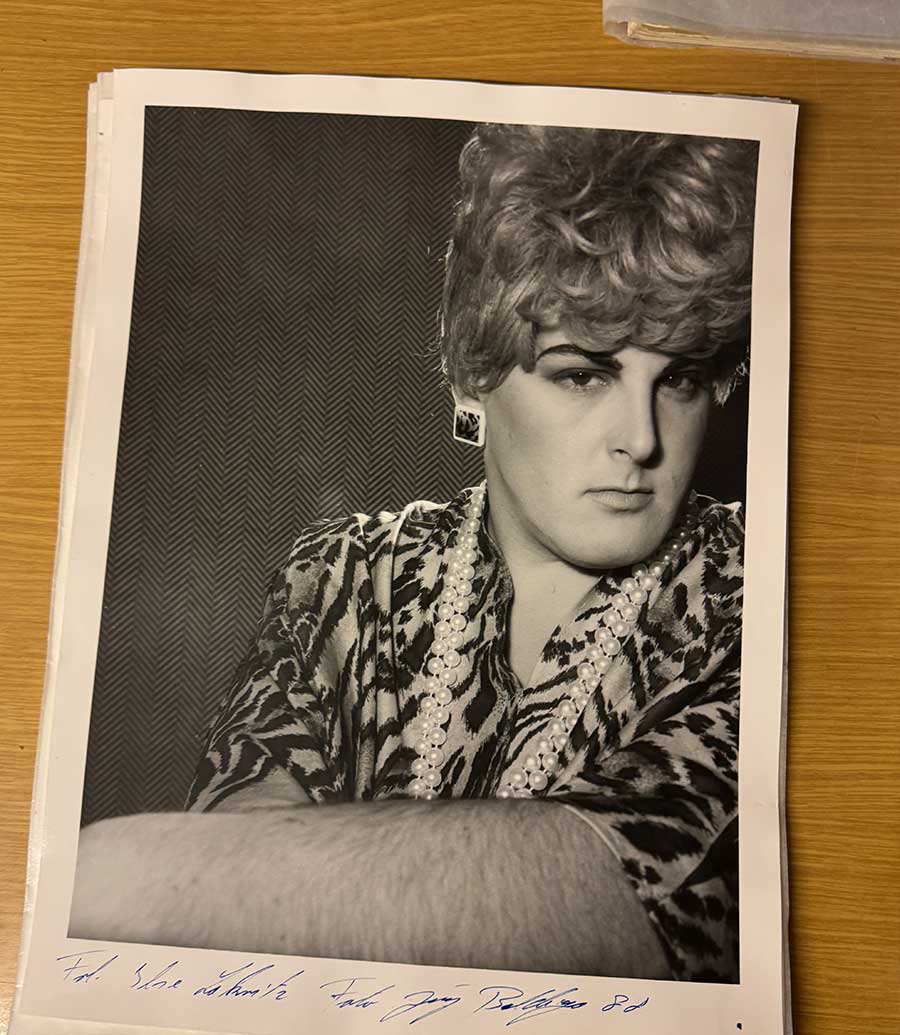


Nachlass Jürgen Baldiga, Schwules Museum, Berlin. Katerina Suverina and Andrei Zavadski, “Challenging the Canon(s) of HIV/AIDS Visual Representation? Two Cases from Central and Eastern Europe”
In preparation for their collaboration, the researchers spent several days at the archive of the Schwules Museum in Berlin, where Jürgen Baldiga’s estate is preserved. Baldiga’s close friend, Aron Neubert, kindly helped them navigate the archival materials associated with Baldiga, shared documents from his personal collection and offered valuable insights into the photographer’s life and work. Khristoforov’s photographs of Soviet people living with HIV were collected, and Katerina Suverina conducted an interview with the photographer as part of her fieldwork.
The preliminary research findings were presented on May 20 during the Zukunftskolleg’s Jour fixe. Katerina Suverina and Andrei Zavadski are continuing their work on the project and currently preparing two academic articles that offer in-depth analyses of the visual and artistic legacies of the two photographers. Moreover, they are aiming to initiate a larger research project on the basis of their collaboration that will inquire into visual histories of HIV/AIDS in the context of (Eastern) Europe and perhaps beyond. Their ultimate goal is to produce a collected volume or similar multi-author publication. To support this effort, the researchers have applied for a grant from the Volkswagen Foundation.

A blank form with an anonymous code for a blood sample tested for HIV.
Photo of Valeri Khristoforov, 1990
TASS Archive
Andrei Zavadski’s appraisal of his stay at the Zukunftskolleg:
“I am immensely grateful for the wonderful month I have spent at the Zukunftskolleg. Not only because it has allowed me to enjoy the beautiful city of Konstanz and to have a very productive time with Katya Suverina but also because in the process of this research I have learnt so much about events in history that many people in Germany – including, embarrassingly, gay men like myself – do not know much about. So, thank you, Katya, and thank you, Zukunftskolleg, for giving me this opportunity.”
Biopolitical Violence and a Society of Hope: HIV/AIDS in the Late USSR
As of 2023, we still know little about the cultural, social and even medical history of the HIV/AIDS epidemic in the late Soviet and post-Soviet periods. HIV/AIDS remains a silenced figure in Russophone contemporary public and academic discourses. At the same time, for most people in Russia, an HIV-positive status has only one meaning: terrible stigma. When was this stigma created: at the beginning of the epidemic in the 1980s – or in the 1990s, after the collapse of the USSR, when intravenous drugs proliferated? Who were the main actors that contributed to the spread of this stigma and violent attitudes towards HIV-positive people? How did different actors in the Soviet system help to create a discourse of inverted care and the culture of stigma? What kind of impact did HIV/AIDS have on health governance, politics and society in general? How did the stigmatized image of HIV-positive people contribute to the spread and consolidation of conspiracy theories, fear and almost pervasive dehumanization during the late Soviet period?